LFP vs NMC battery scooter is a question more Indian buyers are asking, and for good reason. The battery is the heart of any electric scooter. It is the most expensive part. It decides how long your scooter lasts, how safe it is, and how much range you get. So knowing the difference between these two battery types helps you buy smarter.
This guide is written by our team at VD Motors EV. We build and sell electric scooters for daily riders across India. We will explain both battery types in plain language. No heavy engineering talk. Just clear, honest facts about what each one does well, where each one falls short, and which one suits Indian roads and Indian weather better.
Here is everything you should know about LFP and NMC batteries before you buy your next electric scooter.
1. What This Comparison Is About: LFP vs NMC Battery Scooter
- Almost every electric scooter in India today uses a lithium-ion battery. But lithium-ion is not one single thing. It is a family of chemistries. The two you will hear about most on scooters are LFP and NMC. They both store energy and both power your ride. The way they behave is quite different.
- LFP stands for Lithium Iron Phosphate. NMC stands for Nickel Manganese Cobalt. These names describe what the battery cell is made of. That inside recipe changes the safety, the life, the weight, the cost, and how the battery handles heat. Each of these matters a lot for a daily rider in India.
- This comparison keeps things simple. We look at the points that actually affect you as an owner. Range. Life. Safety. Heat. Cost. Charging. By the end you will know which battery type fits your needs and why it matters.
VD Motors EV Perspective The battery is the single most important part of any electric scooter. It shapes safety, life, range, and cost. LFP and NMC are both good chemistries. They are simply built for different priorities. For most daily riders in India, LFP tends to win on safety, life, and heat tolerance. NMC wins on light weight and range in a small pack. |
2. Who We Are and Why It Matters lfp vs nmc battery scooter
Before you trust battery advice from anyone, you should know who is giving it. We are VD Motors EV. We are an Indian electric vehicle brand that designs and sells electric scooters built for daily use. Our vehicles run on LFP batteries and carry a multi-year warranty.
Why does this matter here? Because we work with these batteries every day. We see how they behave on real Indian roads and in real Indian heat. We chose our chemistry after weighing the same points this guide covers. So the comparison below is not just theory. It reflects what we have learned building scooters for this market.
We also believe in being honest. We will not pretend one battery is perfect and the other is useless. Both have real strengths. We will lay out the trade-offs clearly so you can decide what fits your own riding.
Expert Note: There Is No Perfect Battery Every battery chemistry is a set of trade-offs. There is no single winner on every point. The right question is not which battery is best in the world. It is which battery suits your riding and your climate. For hot Indian cities and long daily use that answer often points to LFP. We explain why through this guide. |
3. What Is an LFP Battery
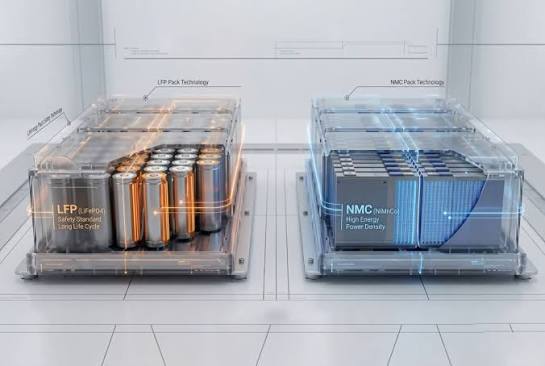
LFP stands for Lithium Iron Phosphate. In technical writing you may see it as LiFePO4. It is a lithium-ion battery that uses iron and phosphate in its positive electrode instead of nickel and cobalt.
The big traits of LFP are safety, long life, and heat tolerance. It is one of the most stable lithium chemistries available. It resists overheating far better than most other types. It also lasts a very long time, holding up over thousands of charge cycles before it wears down. On top of that it uses no cobalt, which makes it cheaper to produce and free of the supply worries that come with cobalt.
The main trade-off is energy density. LFP stores a little less energy for its size and weight. So for the same range an LFP pack is usually a bit heavier and larger than an NMC pack. For a scooter used on daily city routes this small weight difference rarely matters much.
4. What Is an NMC Battery
NMC stands for Nickel Manganese Cobalt. It is a lithium-ion battery that uses nickel, manganese, and cobalt in its positive electrode. It has been popular in electric vehicles for many years.
The big strength of NMC is energy density. It packs more energy into a smaller, lighter cell. So an NMC pack can give more range for less weight and size. This is why it is common in premium EVs where light weight and long range are the top priority. NMC also performs a little better in cold conditions.
The trade-offs are cost, life, and heat behaviour. NMC uses nickel and cobalt, which are expensive and can swing in price. It usually offers fewer charge cycles than LFP, so it may need replacing sooner. It is also less thermally stable, which means it needs careful design and cooling to stay safe, especially in hot climates.
5. LFP vs NMC: The Quick Verdict
If you want the short answer here it is. LFP is the safer, longer-lasting, more heat-friendly, and cheaper choice. NMC is the lighter, more compact choice that gives more range per kilogram. Here is a clear side-by-side of the points that matter to a scooter owner.
Factor | LFP (Lithium Iron Phosphate) | NMC (Nickel Manganese Cobalt) |
Safety | Very high, very stable | Good, needs careful cooling |
Battery life | Longer, thousands of cycles | Shorter, fewer cycles |
Heat tolerance | Excellent, suits Indian heat | Degrades faster in high heat |
Energy density | Lower, slightly heavier | Higher, lighter and compact |
Cold performance | Slightly weaker | Slightly better |
Cost | Lower, no cobalt | Higher, uses cobalt and nickel |
Full daily charging | Handles it well | Best kept below full often |
Best suited for | Daily use in hot climates | Light weight and max range |
Keep this table in mind as we go deeper. Each row below gets a proper explanation so you understand why it matters for your scooter.
6. Energy Density and Weight
Energy density means how much energy a battery holds for its size and weight. This is the one clear area where NMC leads.
NMC stores more energy in a smaller, lighter cell. So an NMC pack can deliver more range without adding much weight or bulk. LFP holds a little less energy for the same size, so an LFP pack is usually slightly heavier and larger for the same range. This is the main reason some premium vehicles still choose NMC.
For a scooter this difference is real but small. A daily commuter is not carrying huge loads or chasing the last kilometre of range. Modern LFP packs give plenty of range for a normal city commute. So while NMC wins this round on paper, the gap rarely changes daily life for a scooter rider.
7. Battery Life and Cycle Count
Battery life is measured in charge cycles. One cycle is roughly a full charge and discharge. The more cycles a battery can handle before it fades, the longer it lasts. This is a big win for LFP.
LFP batteries typically handle far more charge cycles than NMC. Where an NMC pack may last a certain number of cycles, a good LFP pack can last two to three times as many. In real terms this means an LFP battery often stays healthy for many more years of daily use. For a scooter you plan to keep and ride hard every day, that long life is a serious advantage.
A longer-lasting battery also protects your money. The battery is the costliest part of the scooter. A chemistry that delays replacement saves you a large expense down the road. Over the full life of the vehicle this can make LFP the cheaper choice even if the sticker price is similar.
8. Safety and Thermal Stability
Safety is where LFP truly shines, and it deserves real attention. After a few high-profile EV fire incidents in past years, Indian buyers care about battery safety more than ever. They are right to.
LFP is one of the most thermally stable lithium chemistries. It stays calm at much higher temperatures before it breaks down. It is far less likely to go into thermal runaway, which is the dangerous chain reaction behind battery fires. NMC is still safe when it is well designed and well cooled, but it becomes unstable at a lower temperature than LFP. So it demands more careful engineering to stay safe.
For an everyday vehicle parked at home, charged overnight, and ridden in heavy heat, this extra safety margin matters a lot. It is one of the strongest reasons many Indian scooter makers moved toward LFP.

Safety Note: Why LFP Suits Peace of Mind LFP stays stable at much higher temperatures than NMC before any risk of a thermal problem. It is far less prone to thermal runaway, the reaction behind most battery fires. For a scooter charged at home and ridden in Indian heat, that safety margin is genuinely reassuring. |
9. Performance in Indian Heat
India is a hot country for most of the year. In many cities summer temperatures stay high for months. Heat is hard on batteries, so how a chemistry handles heat is a real, practical concern here.
High heat speeds up battery wear and can hurt performance and safety. LFP handles high ambient heat better than NMC. It stays stable and ages more slowly in hot conditions. NMC is more sensitive to heat and can degrade faster when it runs warm often. In a climate like ours this difference adds up over the years.
This is exactly why heat tolerance is not a small detail in India. A battery that stays healthy through hot summers gives you steady range and long life. That is a strong point in LFP's favour for the Indian market, and it is local knowledge that a good scooter maker builds around.
10. Cost and Long-Term Value
Cost matters to every buyer, so let us be clear about it. There are two costs to think about. The upfront cost and the long-term cost.
On raw materials LFP is cheaper. It uses iron and phosphate instead of costly cobalt and nickel. Cobalt in particular is expensive and its price can swing a lot. So LFP tends to be the lower-cost chemistry to produce. On top of that its long life means you are less likely to face an early battery replacement, which is the biggest cost an EV owner can hit.
NMC can cost more both to buy and to replace, though it gives you more range per kilogram in return. So the value question comes down to your priority. If you want the lowest total cost of ownership over many years, LFP usually wins. If you want maximum range in the lightest pack and are willing to pay for it, NMC has its place.
Value Note: Think Total Cost, Not Just Price The cheapest battery on day one is not always the cheapest over the scooter's life. LFP costs less to make and lasts longer, so it often delays the biggest expense of all, a battery replacement. For a daily rider keeping the scooter for years, LFP usually gives the better long-term value. |
11. Charging Habits and Daily Use
How you charge matters as much as the chemistry itself, and here the two behave differently in a way that affects daily life.
NMC batteries last longest when you avoid charging them to a full hundred percent every single time. Many owners are advised to keep them in a middle charge range for best life. LFP is much more relaxed. It handles being charged to full regularly without much stress. For a daily rider who just wants to plug in overnight and wake up to a full battery, that easy-going nature is a real convenience.
So for a simple daily routine, plug in at night and ride full in the morning, LFP fits better. You do not have to babysit the charge level. You just use the scooter and let it charge. For most people that simplicity is worth a lot.
12. Cold Weather Performance
To keep this comparison fair we should give NMC its due on cold weather. This is one area where it has a small edge.
In cold conditions batteries lose some range and charge more slowly. NMC handles low temperatures a little better than LFP and holds range slightly better in the cold. LFP can lose more range when it is very cold. For riders in the hill states or the far north during winter this is worth knowing.
That said, most of India is warm to hot for most of the year. For the large majority of Indian riders, heat is the bigger daily challenge than cold. So while NMC wins the cold round, it is a smaller factor for most buyers in this country than heat tolerance and safety are.
13. Which One Should You Choose
There is no single answer for everyone, so let us make it practical. Choose based on how you ride and where you ride.
Choose LFP if you want the safest option, the longest life, and the best behaviour in Indian heat, and if you want a battery you can charge to full every night without worry. This fits the large majority of daily riders in Indian cities. Choose NMC if your top priority is the lightest possible pack with the most range per kilogram, and you are willing to pay more and manage the charge level carefully.
For most people reading this the honest recommendation is LFP. It matches the way daily riders in India actually use and charge their scooters, and it matches our climate. NMC remains a fine chemistry with real strengths, but its advantages matter most in situations that few daily scooter riders face.
14. Why VD Motors EV Chooses LFP
Here is how we made our own choice, and why. We build electric scooters for daily riders across India. When we weighed the same points in this guide, LFP came out ahead for our market and our riders.
We use LFP batteries across our range because safety and long life matter most to a daily rider, and because LFP handles Indian heat so well. It lets our riders charge to full every night without stress. It resists the heat that our climate throws at it. It lasts for years of daily use. And it keeps the long-term cost of ownership low, which protects our riders' money.
We made this choice with the same honest, practical thinking we share in this guide. For a scooter meant to be ridden every day in Indian conditions, LFP simply fits best. That is the reasoning behind the battery in every VD Motors EV scooter.
Quick Summary: LFP vs NMC for a Scooter
● LFP is safer, more thermally stable, and better in Indian heat.
● LFP lasts far longer, with more charge cycles over its life.
● LFP is cheaper to make and gives better long-term value.
● LFP can be charged to full every night without much wear.
● NMC is lighter and more compact, with more range per kilogram.
● NMC performs a little better in cold conditions.
● For most daily riders in India, LFP is the better fit.

Closing Thoughts
The LFP vs NMC battery scooter question comes down to priorities. Both are proven lithium chemistries. Both will power your ride well. They are simply built for different goals.
NMC leads on energy density, light weight, and cold performance. LFP leads on safety, battery life, heat tolerance, cost, and easy daily charging. When you line these up against how a scooter is actually used in India, a hot climate, daily commutes, overnight charging, and a wish for long life and safety, LFP fits the way most Indian riders live.
So when you shop for an electric scooter, ask about the battery chemistry and the warranty. Understand what you are buying. If you want a safe, long-lasting daily rider suited to Indian conditions, an LFP scooter is a smart, sensible choice. When you are ready to see one, VD Motors EV is ready to help.
Frequently Asked Questions
These are the questions Indian riders ask us most about LFP and NMC scooter batteries.
FAQ 1: Which battery is better for a scooter, LFP or NMC?
For most daily riders in India, LFP is the better choice. It is safer, lasts longer, handles heat better, and costs less over the long run. NMC is lighter and gives more range per kilogram, which suits buyers who want maximum range in the smallest pack and will pay more for it.
FAQ 2: Is an LFP battery safer than NMC?
Yes. LFP is one of the most thermally stable lithium chemistries. It stays calm at much higher temperatures and is far less likely to go into thermal runaway, which is the reaction behind most battery fires. NMC is safe when well designed and cooled, but it becomes unstable at a lower temperature than LFP.
FAQ 3: Does an LFP battery last longer than NMC?
Generally yes. LFP typically handles far more charge cycles than NMC, often two to three times as many. In real use this means an LFP battery usually stays healthy for many more years of daily riding, which also delays the costly job of replacing it.
FAQ 4: Which battery is better for Indian heat?
LFP. It handles high ambient temperatures better and ages more slowly in the heat. NMC is more sensitive to heat and can degrade faster when it runs warm often. In a hot country like India this makes LFP a strong choice for steady range and long life.
FAQ 5: Is NMC better than LFP for range?
For range per kilogram, yes. NMC has higher energy density, so it packs more energy into a lighter, smaller cell. LFP is slightly heavier for the same range. For a normal city commute, though, a modern LFP scooter still gives plenty of range for daily needs.
FAQ 6: Can I charge an LFP battery to full every night?
Yes. LFP handles being charged to a full hundred percent regularly without much stress. This makes it very convenient for daily riders who just want to plug in overnight. NMC lasts longest when you avoid full charges often, so it needs a little more care.
FAQ 7: Is LFP cheaper than NMC?
Usually yes. LFP uses iron and phosphate instead of costly cobalt and nickel, so it is cheaper to produce. Its long life also lowers the chance of an early, expensive battery replacement. That makes LFP the better value for most owners over the life of the scooter.
FAQ 8: Which battery does VD Motors EV use?
We use LFP batteries across our range. We chose LFP because safety, long life, and heat tolerance matter most to a daily rider in Indian conditions, and because it lets riders charge to full every night without worry. It is the chemistry that best fits how our riders use their scooters.
How-To: Check Your Scooter's Battery Type
Here is a simple way to find out what battery your electric scooter uses before you buy.
1. Ask the dealer directly whether the battery is LFP or NMC.
2. Check the scooter's spec sheet or brochure for the battery chemistry.
3. Look for the terms Lithium Iron Phosphate, LFP or LiFePO4 for an LFP pack.
4. Look for Nickel Manganese Cobalt or NMC for an NMC pack.
5. Ask about the battery warranty, in years and in coverage.
6. Ask how the battery handles heat, since this matters a lot in India.
7. Confirm whether you can safely charge it to full every day.
8. Compare two models on chemistry, warranty and life, not just price.